


People have always been fascinated by flight and the desire to push boundaries, including the limits of speed. From the ground, it can be hard to believe how quickly a passenger jet really moves as it appears to glide leisurely across a blue sky. Everything looks different in the air, and the figures describing aircraft performance can be astonishing. Passengers often wonder how fast the aircraft they are travelling in is flying, whether they are heading to a holiday destination or a business meeting. There is no single answer: speed depends on the aircraft's purpose and design, its chosen altitude, air density and current weather conditions, such as the wind at high altitude.
Commercial air travel: the usual speed in the sky
Most passengers regularly travel on conventional airlines. The question of how fast a passenger aircraft flies is closely tied to economics and physics. The most popular medium-haul jets typically cruise at 800 to 850 kilometres per hour. Larger wide-body aircraft used for intercontinental flights can reach around 900–930 kilometres per hour.
In aviation, speed is often expressed as a Mach number: the ratio of an object's speed to the speed of sound in the surrounding medium. Modern airliners fly in the subsonic range, usually at Mach 0.78 to 0.85.
Why not fly faster? Breaking the sound barrier creates enormous aerodynamic drag, sharply increasing fuel consumption and making tickets less economical while harming the environment.
Speed in the skies: a comparison of records
A table makes it easier to compare the performance of different types of aircraft.
| Aircraft type and model | Purpose | Average maximum / cruising speed | Mach number |
|---|---|---|---|
| Tecnam P2008 / Cessna 152 | Flight training (GA) | approx. 180 – 210 km/h | < 0.2 Ma |
| Boeing 737 / Airbus A320 | Commercial passenger aircraft | approx. 800 – 850 km/h | 0.78 – 0.82 Ma |
| Boeing 787 Dreamliner | Long-haul passenger aircraft | approx. 900 – 930 km/h | approx. 0.85 Ma |
| Concorde | Supersonic passenger aircraft | approx. 2,150 km/h | 2.04 Ma |
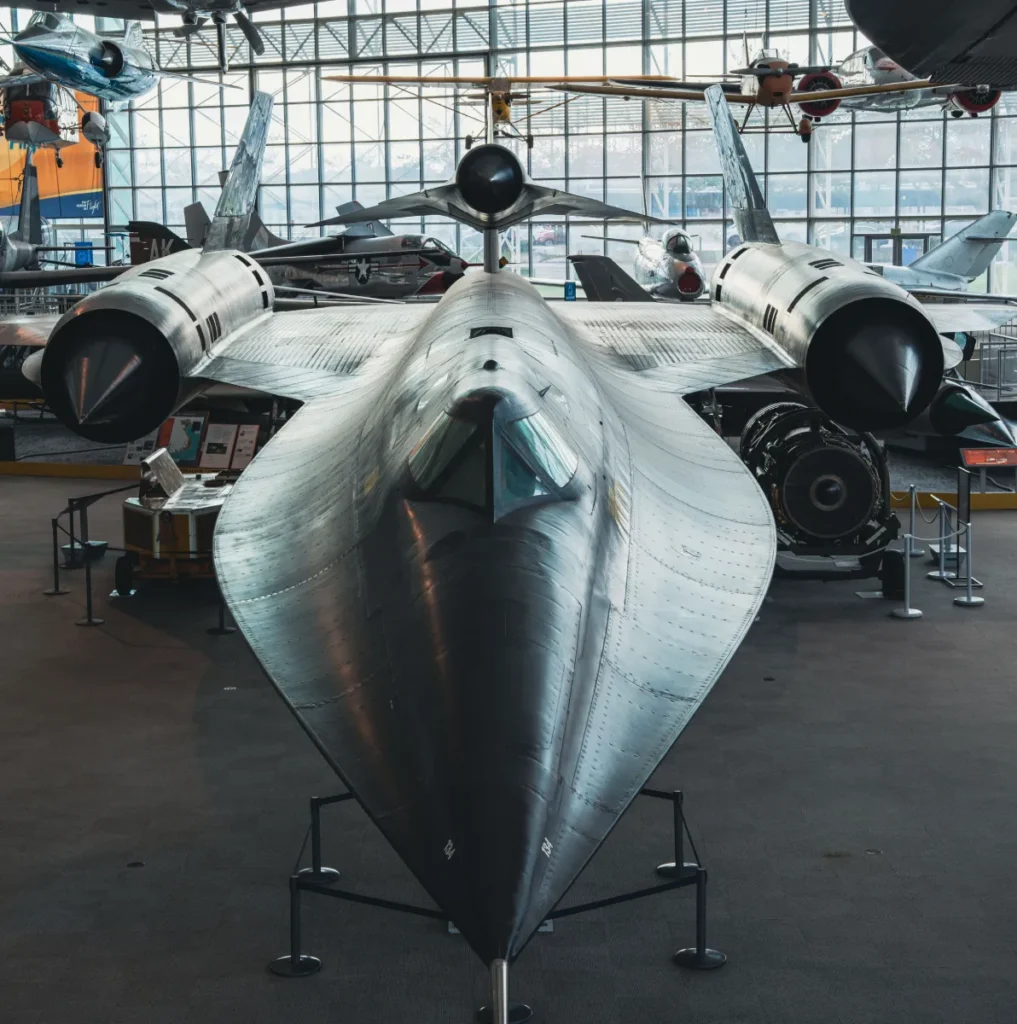
| Lockheed SR-71 Blackbird | Military reconnaissance aircraft | approx. 3,530 km/h | 3.3 Ma |
Supersonic icons: the fastest passenger aircraft in history
There was a remarkable period in commercial aviation when journey time mattered more than environmental cost: the era of the legendary Concorde. This Franco-British project remains a symbol of luxury and technological achievement. It was undoubtedly the fastest passenger aircraft ever to enter regular airline service.
The Concorde could cruise at the astonishing speed of Mach 2.04. A flight from Paris or London to New York took less than three and a half hours, so passengers landed in the USA at a local time earlier than their departure time in Europe. The aircraft was retired in 2003 for economic reasons, but today's aviation start-ups are working to bring back supersonic passenger travel in a quieter form.
Breaking barriers: what is the fastest aircraft in the world?
Leave the limits of civil transport behind and turn to military and research projects, and you enter a world of very different speeds. To answer the question what the fastest aircraft in the world is, we need to go back to the Cold War. It was then that aircraft were developed which have yet to be surpassed for the speed achieved by crewed jet aircraft.
The unofficial king of the skies is the Lockheed SR-71 Blackbird. Designed in the 1960s, this American reconnaissance aircraft remains the world's fastest aircraft. It could exceed Mach 3.3. The Blackbird flew so fast and so high that its main defence against enemy surface-to-air missiles was simply to accelerate and outrun them.
The experimental North American X-15 rocket plane also deserves a mention. In 1967 it set the absolute speed record for a crewed aircraft, reaching an incredible 7,274 kilometres per hour (Mach 6.7).
Flight training: speed in general aviation
In the everyday work of pilots, especially those taking their first steps at flight schools such as Ventum Air, speed has a different, more practical meaning. Aircraft used for basic training fly at speeds much closer to those of road traffic.
In flight training, chasing records takes a back seat for several reasons:
- handling precision – students first need to feel how an aircraft behaves at lower speeds;
- time to decide – a lower speed gives a student pilot more time to assess a situation and respond correctly;
- procedural safety – mastering take-offs, landings and emergencies requires precise control of the aircraft's characteristic speeds.
Paradoxically, learning to control lower speeds is essential: without it, no pilot could go on to fly powerful, fast passenger jets. Every Boeing captain started in aircraft that flew more slowly than cars on a motorway.
Summary
Speed has always driven the development of aviation, and it will continue to do so. From calm training flights in general aviation to commercial airline services and military aircraft that push the limits of human capability, movement through the air fascinates pilots and passengers alike.
If you would like to experience what it is like to control an aircraft's speed and take off yourself, it is time to swap the passenger seat for the pilot's seat. Explore our professional flight training and start your own adventure in the sky with Ventum Air today!
Don't just admire speed. Learn to control it.
Every jet pilot began with a first take-off and learned to handle a training aircraft. Explore Ventum Air flight training and start your own journey from the ground to the cockpit.