

Have you ever stood on an airport apron and looked up at a metal colossus about to leave the ground? People have been fascinated for decades by the way the world's largest aircraft overcome gravity. They are not only triumphs of engineering, but proof that the limits of human capability keep moving. At Ventum Air, we know that every great Captain began with a small aircraft and a big dream. This article ranks 10 powerful designs that have dominated the sky. You will learn which aircraft has the widest wingspan, how much the heaviest transporter weighs and how you can take your first step towards the cockpit of such giants.
What is the world's largest aircraft? The all-time record holders
The definition of ‘largest’ in aviation is open to debate. Engineers disagree on whether wingspan, fuselage length or maximum take-off weight (MTOW) should decide. For years, the undisputed king was the Antonov An-225 Mriya. Built to transport the Soviet Buran space shuttle, this six-engined giant weighed 285 tonnes empty. Sadly, in February 2022, news spread around the world that it had been destroyed at Hostomel Airport near Kyiv. Even so, the Mriya still holds 240 world records, including the record for the heaviest payload at 253 tonnes.
The title for the aircraft with the widest wingspan now belongs to the Stratolaunch Roc. This twin-fuselage giant was designed as an airborne launch platform for rockets. Its wings span 117 metres, longer than a football pitch at Warsaw's National Stadium. Although the Roc does not carry passengers, seeing it in the sky is breathtaking.
| Aircraft model | Wingspan | Length | Maximum take-off weight (MTOW) |
|---|---|---|---|
| Stratolaunch Roc | 117 m | 73 m | 589,670 kg |
| Antonov An-225 (historic) | 88.4 m | 84 m | 640,000 kg |
| Airbus A380-800 | 79.75 m | 72.7 m | 575,000 kg |
| Boeing 747-8 | 68.4 m | 76.3 m | 447,700 kg |
| Antonov An-124 Ruslan | 73.3 m | 68.9 m | 402,000 kg |
What are the 10 largest aircraft in the world?
Here are the aircraft that define modern air transport and the power of engineering.
- Stratolaunch Roc – The outright leader by wingspan, powered by 6 Pratt & Whitney engines and supported by 28 landing-gear wheels.
- Antonov An-225 Mriya – Although it no longer physically exists, its technical specifications remain a benchmark for designers. Its cargo hold was 43 metres long.
- Airbus A380-800 – The largest passenger aircraft ever to enter series production. Its two decks can accommodate as many as 853 people.
- Boeing 747-8 – The newest and longest version of the legendary Jumbo Jet. Its length of 76.3 metres makes it the longest passenger aircraft in service.
- Antonov An-124 Ruslan – The Mriya's smaller sibling, still actively used to carry heavy machinery, helicopters and turbines.
- Lockheed C-5 Galaxy – An American military giant capable of carrying two M1 Abrams tanks or 6 Apache helicopters over thousands of kilometres.
- Hughes H-4 Hercules (Spruce Goose) – A historic record holder from 1947. Built almost entirely from birch wood, it made only one flight at a height of 21 metres.
- Airbus A340-600 – For years the world's longest aircraft at 75.3 m, until the Boeing 747-8 overtook it. It is recognisable by four engines beneath slender wings.
- Boeing 777-9 – The largest twin-engined jet, with unique folding wingtips that allow it to fit standard airport gates.
- Antonov An-22 – The world's largest turboprop aircraft. Its four engines drive contra-rotating propellers, generating enormous noise and thrust.
The largest passenger aircraft: Airbus A380, king of the sky
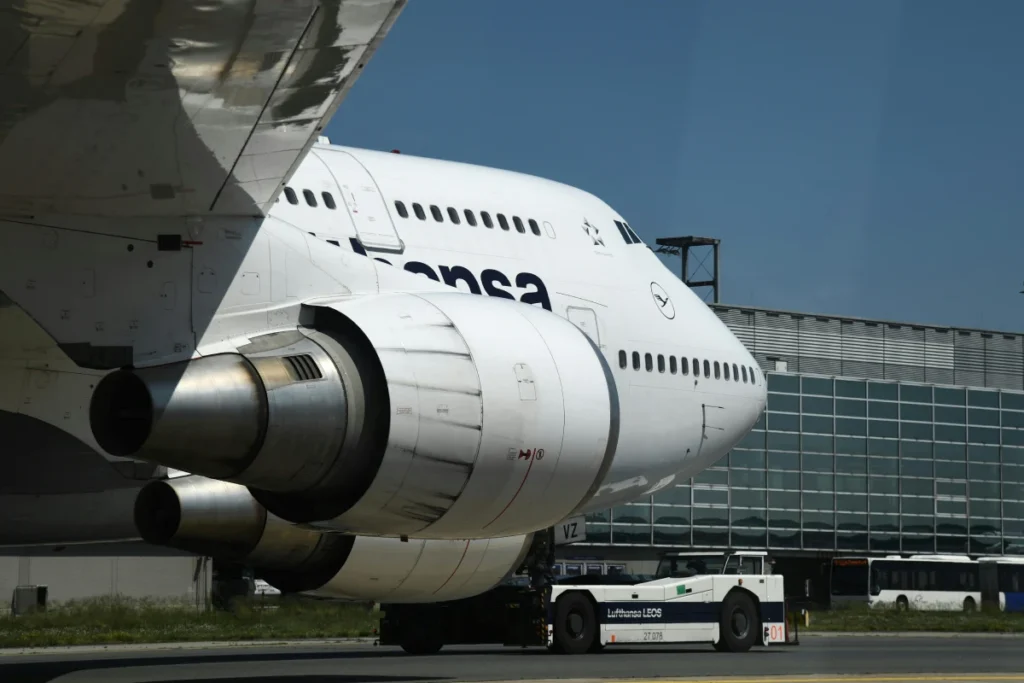
When the Airbus A380 first took to the air in 2005, the world held its breath. It is a genuine flying hotel. Its wing area is 54% larger than that of the Boeing 747-400. Airlines such as Emirates and Singapore Airlines fitted these aircraft with luxury suites, showers and even bars for business-class passengers.
Why, then, did A380 production end in 2021? The reason was its enormous operating cost. Four jet engines consume vast quantities of fuel. With current prices and pressure for more sustainable aviation, airlines prefer smaller twin-engined aircraft such as the Airbus A350. Passengers nevertheless love the A380 for its quiet cabin and stable flight.
Which is larger: the Airbus A380 or Boeing 747?
Almost every aviation enthusiast asks this question. The answer depends on what you measure. The Airbus A380 is taller, reaching the height of an 8-storey building, and wider. The Boeing 747-8, however, has the longer fuselage.
| Feature | Airbus A380-800 | Boeing 747-8 |
|---|---|---|
| Height | 24.1 m | 19.4 m |
| Length | 72.7 m | 76.3 m |
| Number of decks | 2 (full length) | 1.5 (the distinctive hump) |
The largest transport and military aircraft
Payload is what matters in logistics. Aircraft with specialised designs dominate here. The Airbus A300-600ST Beluga and newer Beluga XL look extraordinarily bulky. Their unusually swollen fuselages carry parts of other aircraft between factories across Europe. The Boeing Dreamlifter performs a similar role, transporting fuselage sections for the 787 Dreamliner.
In the military sector, the Lockheed C-5 Galaxy mentioned above leads the field. Its nose lifts upwards and its landing gear ‘kneels’, allowing heavy vehicles to drive straight in from the apron. These aircraft need runways with enough bearing strength not to give way beneath half a million kilograms.
From passion to cockpit: how do you fly giant aircraft?
Looking at these metal colossi, have you wondered whether you could become their pilot? The answer is yes, but the route to an Airbus A380 or Boeing 747 cockpit passes through smaller aircraft. Every airline pilot began at the controls of a simple Cessna 152 or 172. Aircraft like these are where Ventum Air teaches the fundamentals of flying.
A PPL(A) licence is the first step. You then progress through professional training, build flight time and learn to work in a multi-pilot crew. Flying a giant aircraft carries immense responsibility, but also incomparable satisfaction. Our instructors have airline experience and will guide you through the process step by step.
Summary
Exploring a ranking dominated by the world's largest aircraft is only an introduction to the fascinating world of aviation. You have learned that the Stratolaunch Roc leads in wingspan, the Airbus A380 is the passenger giant and the destroyed Mriya remains a transport legend. Remember that people stand behind every one of these aircraft: pilots who, like you, once felt a thrill at the sight of an aeroplane for the first time.
Aviation is an industry that does not forgive mistakes, but rewards the most persistent with remarkable views and prestige. If you dream of one day taking the controls of a jet, do not wait for a better moment. Your route to the sky starts with deciding to take an introductory flight. Enrol on professional training at Ventum Air and turn dreams of flying into practical skills. Our school is where passion meets professionalism.
The sky is not the limit – it is the destination.
Professional flight training with instructors who have airline experience, from PPL(A) to a career in the cockpit.